Announcement
Napoland Is Now Open Source
The code, the maps and the roadmap are public
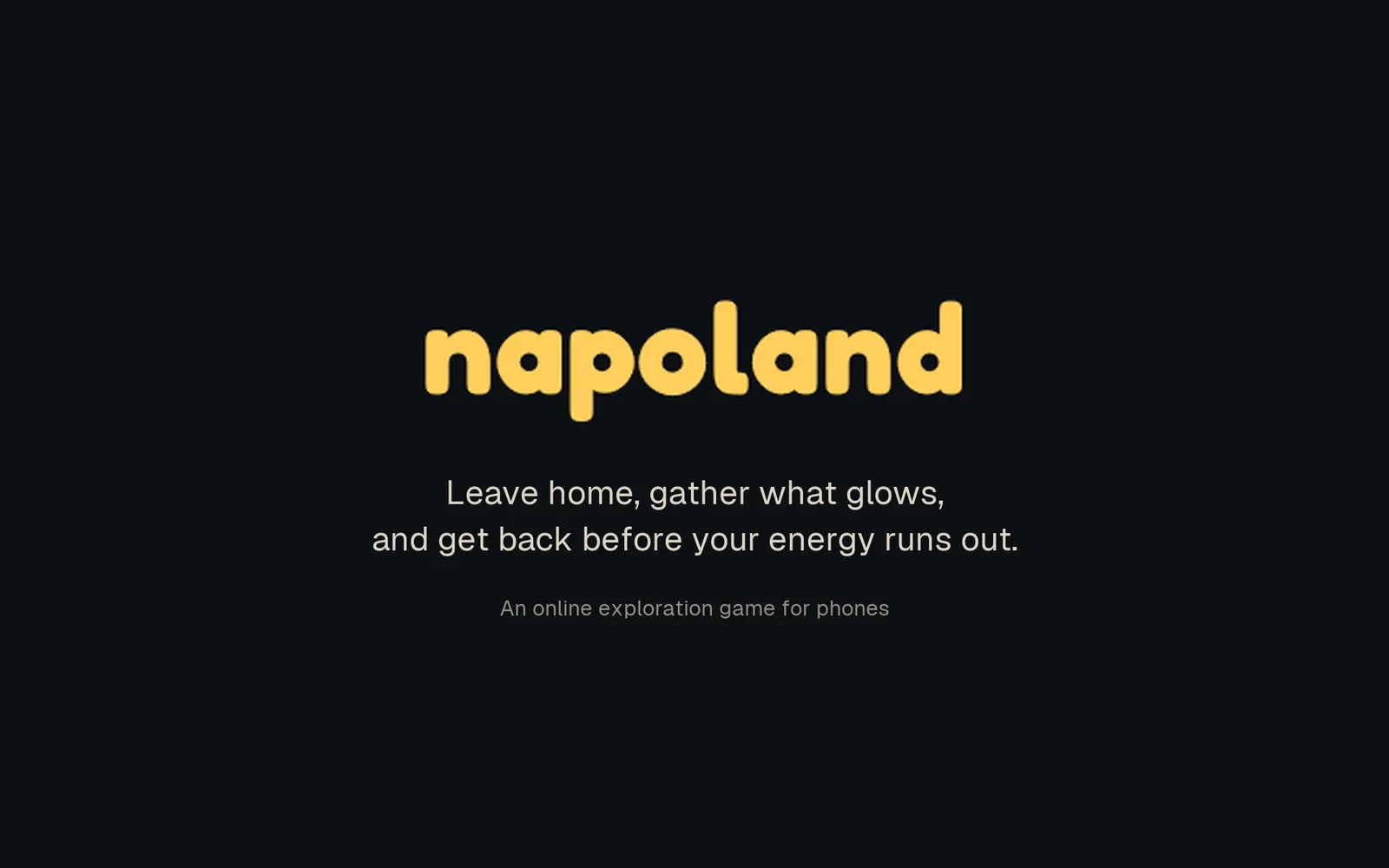
Napoland is an online exploration game made for phones and played in the browser. Starting today, the whole game is public on GitHub: the code under the AGPL-3.0, the maps and items under Creative Commons BY-SA 4.0, and the roadmap alongside them.
The game
You live in Stonebrook, a small town at the edge of a dark Pacific Northwest forest. Out there, under the firs and the rain, mushrooms glow, abandoned cars rust by the old road and a few cabins keep a fire burning.
The farther you walk, the better the finds — and the faster your energy drains. So every trip is a choice: one more find, or turn back now. Nothing on screen tells you where you are; you learn the world by walking it. There are no fights and no player-versus-player: other players are only ever help.
It needs nothing but a browser. Open napoland.com, sign in with a six-digit code sent to your email, and play with a joystick and two buttons.
Why open source
A game about exploring a shared world should be shaped by the people who explore it. With the code, the maps and the roadmap in the open, anyone can see where Napoland is going — and help take it there.
How to contribute
Pull requests are welcome, and not only for code: maps, items, ideas, bug reports and play-testing on real phones all count.
- Start with the contributing guide: how to set up, the checks every change passes and how pull requests are reviewed.
- The roadmap is a folder in the repository, one file per item, each with its status — done, now, next, planned or idea. To propose something, open a pull request.
- Pick something from the open issues.
Run it on your computer
You need Node.js 24 and git:
git clone https://github.com/napoland-com/napoland.git
cd napoland
npm install
npm run dev
The game opens at localhost:5173, with the game server on port 8080. Open a second tab to see two players — or your phone on the same Wi-Fi.
About the licenses
The code is licensed under the GNU Affero General Public License, version 3 or later: you can study, change and share it, and if you run a changed version as an online service, you offer its source to its players too. The world itself — maps, rooms, items and their texts — is shared under Creative Commons Attribution-ShareAlike 4.0. Either way, improvements come back to everyone who plays.